






09 Jun How does the brain clean itself?
Our brain is one of the most active organs in the body. Every second, billions of neurons exchange electrical and chemical signals. This intense activity allows us to move, think, remember,and adapt. But, it also produces molecular waste.
Indeed, while the brain is functing, proteins are produced, modified, damaged, recycled. Some of these proteins are harmless when they are correctly processed, but can become problematic when they accumulate. One well-known example is amyloid-β, a small protein fragment that can aggregate in Alzheimer’s disease.
But how does the brain clean itself?
The answer is not a single mechanism. The brain uses several clearance routes, working in parallel and probably interacting with each other. Understanding these routes is important because Alzheimer’s disease may not only result from producing too much toxic protein. It may also result, at least partly, from removing too little over many years.
A protected organ, but not an isolated one
The brain has a specific challenge. It is protected from the rest of the body by the blood–brain barrier, a thin and highly selective interface between blood vessels and brain tissue. This barrier is essential. It prevents many harmful substances in the blood from entering the brain and helps maintain a stable environment for neurons.
But this protection also creates constraints. Waste molecules cannot simply diffuse freely from the brain into the blood. They must be transported, degraded, or carried away through specialized pathways.
The brain is also enclosed within the skull. There is very little room for large changes in volume. Fluid movement, vascular pulsation and tissue deformation therefore occur in a confined mechanical environment. This is one reason why brain clearance is not only a biological question. It is also a physical one.
Several routes for removing amyloid-β
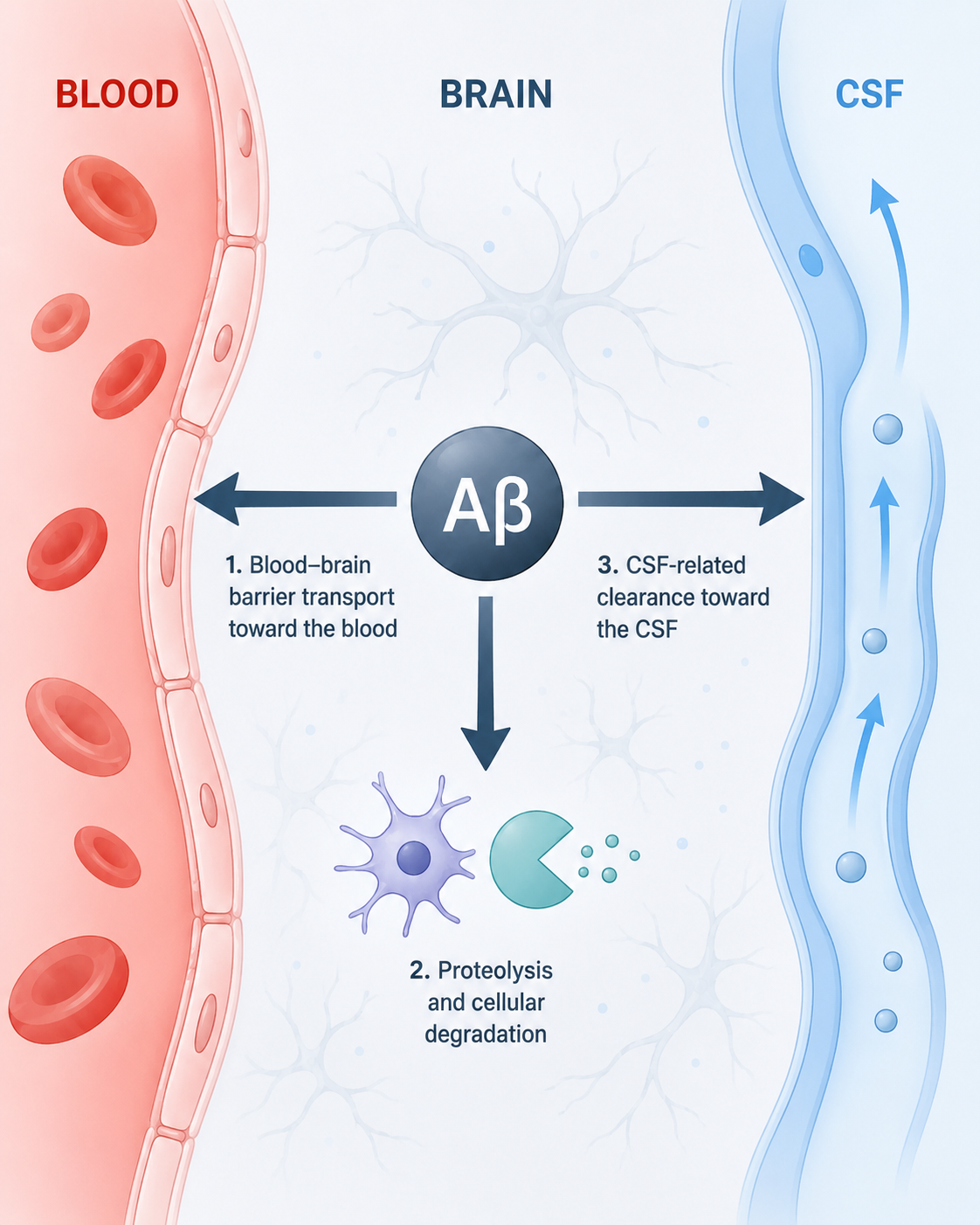
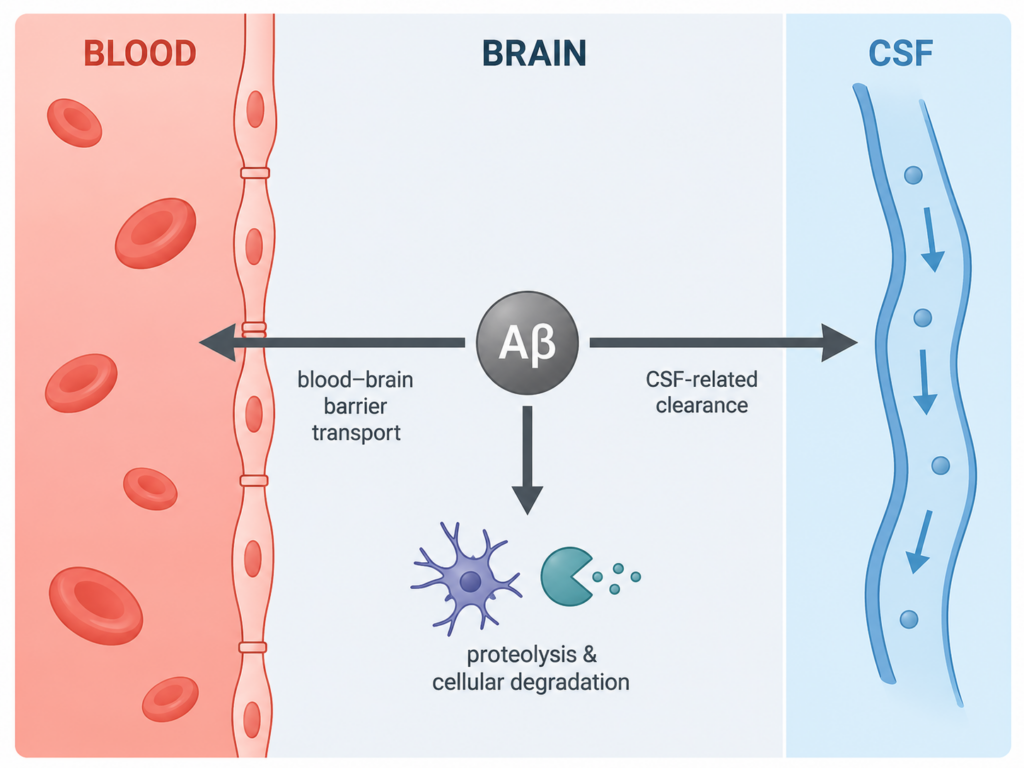
Amyloid-β can be cleared from the brain through several mechanisms. Their relative importance is still debated and probably depends on the molecular form of amyloid-β, brain region, age, vascular health, sleep state and disease stage. Still, three broad families of clearance pathways are commonly discussed.
The first route is transport across the blood–brain barrier. Some amyloid-β molecules can be transported from brain tissue into the blood through specialized receptors and transport systems located on brain blood vessels. This pathway is often considered one of the major routes for removing soluble amyloid-β from the brain.
The second route is local degradation and cellular uptake. Enzymes can break down amyloid-β, and brain cells such as microglia and astrocytes can participate in recognizing, internalizing and processing waste molecules. This local degradation system is essential because it can act close to the site where waste is produced.
The third route involves cerebrospinal fluid, or CSF. CSF is the clear fluid that surrounds the brain and spinal cord and fills the brain ventricles. Over the last decade, increasing attention has been given to the idea that CSF can exchange with fluid inside the brain tissue, especially along perivascular spaces — narrow spaces surrounding blood vessels. This CSF–interstitial fluid exchange is often discussed in relation to the glymphatic system.
In this view, brain clearance depends not only on molecular transporters and cellular degradation, but also on fluid movement through complex anatomical spaces. Amyloid-β and other solutes may be displaced, mixed, diluted or drained through CSF-related pathways.
Why this matters for Alzheimer’s disease
Alzheimer’s disease develops over many years. Long before symptoms become visible, molecular changes may already be occurring in the brain. Amyloid-β accumulation is one of the earliest biological signs associated with the disease.
A useful way to think about this accumulation is as a long-term imbalance. At every moment, amyloid-β is produced and removed. If removal is efficient, the system may remain stable. If clearance becomes slightly less efficient over many years, amyloid-β can progressively accumulate.
This shift in perspective is important. It means that the question is not only: how can we remove plaques once they are already present? It is also: how can we preserve or support the brain’s natural capacity to remove waste before accumulation becomes advanced?
This does not replace existing therapeutic strategies. Rather, it opens a complementary direction. Instead of acting only at late stages, we may need to understand the earlier physiological conditions that make clearance efficient or inefficient.
What current treatments tell us
Recent anti-amyloid immunotherapies have changed the Alzheimer’s disease field. These treatments are designed to target amyloid-β and promote its removal from the brain. They show that modifying amyloid burden is biologically possible.
At the same time, these therapies are not simple preventive tools for the general population. They are generally intended for selected patients at early clinical stages, require confirmation of amyloid pathology, and need careful medical monitoring. They can also cause adverse effects, including amyloid-related imaging abnormalities, which may involve brain swelling or small hemorrhages.
This makes the question of natural clearance even more relevant. If amyloid-β accumulation is partly related to impaired removal, then understanding physiological clearance pathways could help identify people at risk earlier, support prevention strategies, and complement pharmacological approaches.
Why CSF-related clearance is scientifically exciting
Among the brain’s clearance routes, CSF-related clearance is especially interesting for BrainSomnia because it may depend on physical drivers.
Fluid does not move through the brain by magic. It needs forces. These forces may come from pressure gradients, breathing, cardiac pulsations, slow vascular diameter changes, or tissue deformation. Blood vessels are not rigid tubes. They expand and contract. These movements can create mechanical forcing on the surrounding fluid spaces.
This is where the project’s central idea emerges. If vascular pulsations help drive CSF–brain exchange, then changes in these pulsations could change the efficiency of brain clearance. And if these pulsations are altered during ageing, sleep disorders or neurodegenerative disease, they may contribute to long-term waste accumulation.
The challenge is that these mechanisms are difficult to measure directly. Fluid velocities in the brain can be extremely small. Perivascular spaces are narrow. Transport depends on geometry, tissue properties, pulsation frequency, pulsation amplitude and molecular diffusion. This is why BrainSomnia combines imaging, experiments and computational modelling.
The objective is not only to observe that the brain clears waste. It is to understand which physical mechanisms make this clearance more or less efficient.
From brain cleaning to biomechanical sleep quality
Sleep adds another important dimension. Experimental studies suggest that sleep can enhance the exchange between CSF and brain tissue and promote the removal of waste molecules. This may help explain why chronic sleep disruption is associated with increased risk of cognitive decline and dementia.
But sleep is not only a state of reduced consciousness. It is also a state in which brain activity, blood flow, vessel diameter and CSF dynamics change. BrainSomnia explores the possibility that some of these sleep-related mechanical rhythms are important for clearance.
In this view, a good night of sleep is not only defined by how long we sleep or how many times we wake up. It may also depend on whether the physical rhythms of the sleeping brain support efficient transport and waste removal.
The idea behind BrainSomnia
If CSF brain clearance depend on mechanical forces generated by vascular pulsations, then understanding these forces may help us detect, and one day improve, the brain’s ability to clean itself.
